What is a bill of lading in international shipping? A bill of lading is the single most important document in shipping. It is your proof of shipment, your legal contract with the carrier, and the key that unlocks your cargo at the destination.
This guide will explain everything you need to know about a bill of lading: what details it has, how it works, the different kinds, and how to handle it correctly.
What Is a Bill of Lading in Shipping?
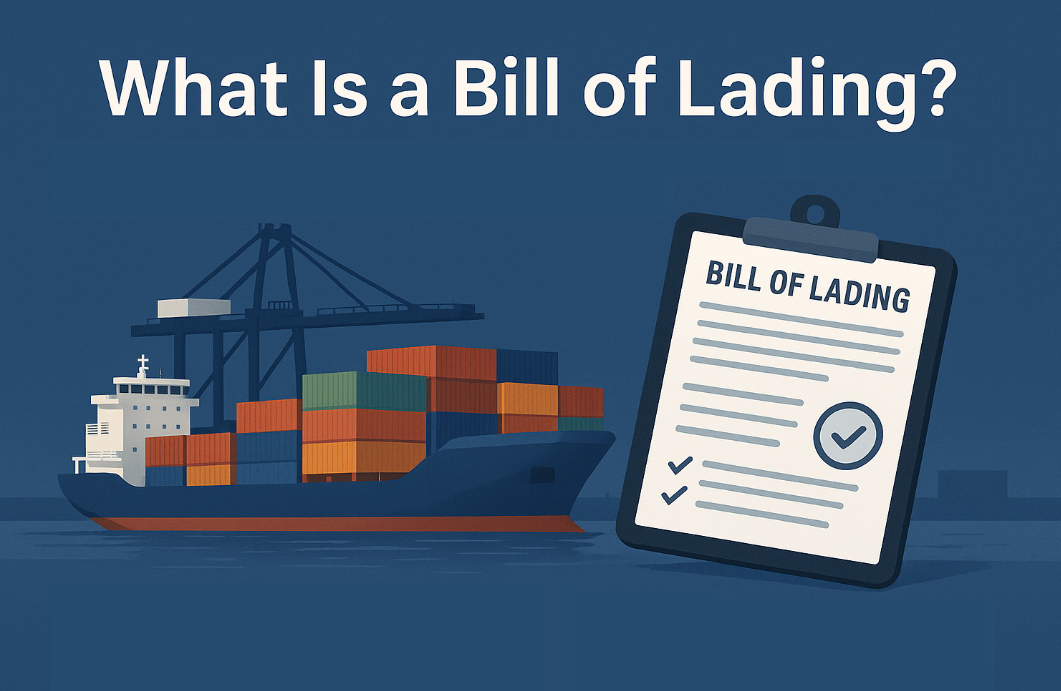
A bill of lading, often called BoL or B/L, is a shipping document issued by a carrier to acknowledge receipt of goods for transportation. It records important shipment details, including the cargo, quantity, shipper, consignee, and destination.
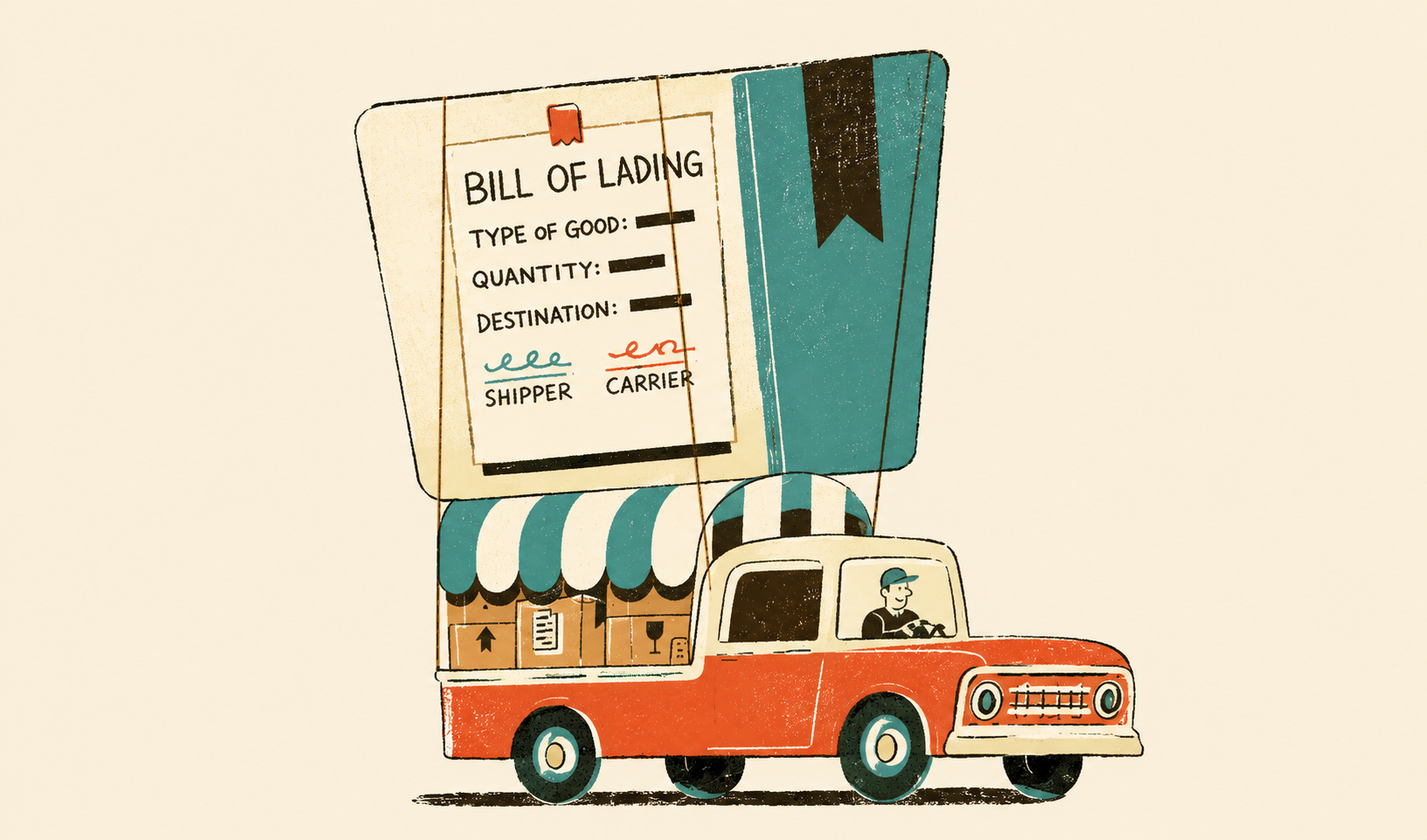
Bills of lading are widely recognized under international shipping conventions such as the Hague Rules and Hague-Visby Rules, which establish the legal relationship between shippers and carriers.
What Information Does a Bill of Lading Form Contain?
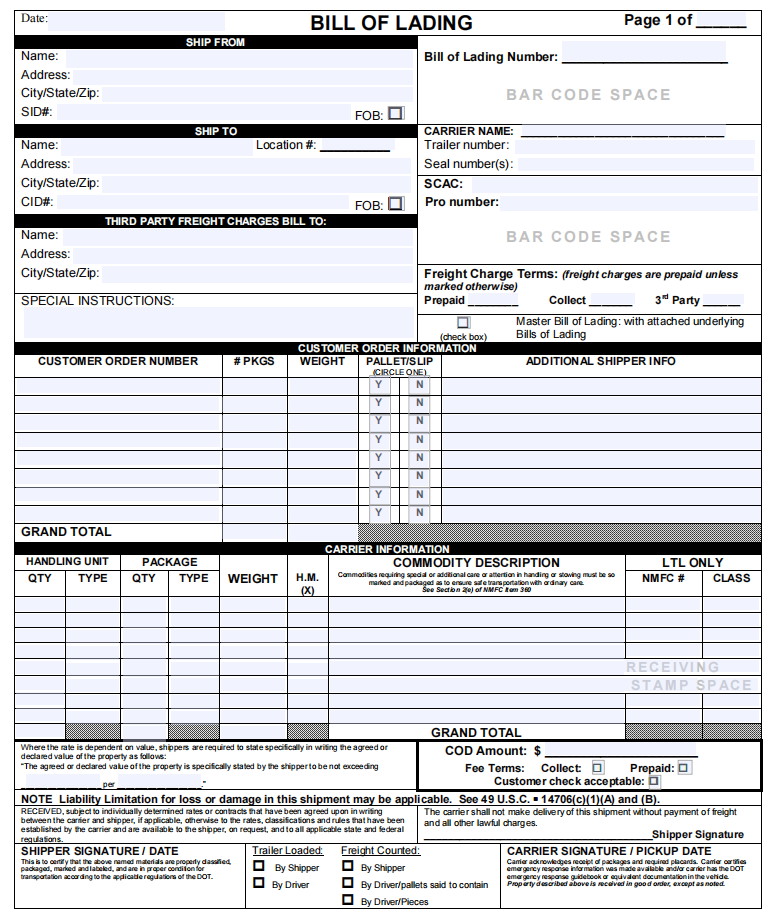
A bill of lading form contains the details of the shipper and consignee, cargo description, quantity, weight, port of loading, port of discharge, HS codes, Incoterms, freight payment terms, and the carrier’s signature.
Each part of the form has a specific reason for being there. If you miss filling out any part, your whole shipment could be delayed.
Here are the main key fields:
| Field | What It Means |
| Shipper name & address | Who is sending the goods — full legal name and address |
| Consignee name & address | Who is receiving the goods — same level of detail |
| Notify party | Who to alert when goods arrive, often the buyer or their agent |
| Bill of lading number | Your unique tracking reference for the entire shipment |
| Vessel/carrier name | The ship or transport company moving your cargo |
| Port of loading | Where your goods are handed over to the carrier |
| Port of discharge | Where your goods will be released |
| Description of goods | What is being shipped — be specific, not vague |
| Quantity & weight | Exact number of units and total weight |
| Packaging type | Pallets, cartons, drums, containers, etc. |
| HS codes | Required for customs classification at the destination |
| Incoterms | Who bears the cost and risk at each stage |
| Freight charges | Prepaid (shipper pays) or collect (consignee pays) |
| Bill of lading date | The date the carrier issues the document |
| Special instructions | Temperature control, fragile handling, and delivery appointments |
| Signature | Carrier’s confirmation that goods were received as stated |
Note: these fields are for a standard bill of lading. Depending on your shipment, the carrier might ask for more information. If you are not sure, ask your freight forwarder to fill out the bill of lading for you. Fixing mistakes in this document after the ship has left can be expensive.
Bill of Lading Template
Below is a standard bill of lading example. You can use it as a reference to understand the layout and what goes in each field:
How a Bill of Lading Works
The bill of lading will move with your whole shipment from the moment goods leave the warehouse to the moment they arrive at the destination.
Here is exactly how a bill of lading in shipping works – step by step:
Step 1: The shipper books a shipment
You contact a carrier or freight forwarder and share the details: what you’re shipping, how much, where it’s going, and any special requirements.
Step 2: The BoL is created
Once the booking is confirmed, the bill of lading is drafted by the shipper, the forwarder, or through the carrier’s system.
Step 3: The carrier picks up the goods and signs
The driver arrives, checks the cargo, and signs the BoL. That signature means one thing: “We received these goods, in this condition, at this time.”
Step 4: The BoL travels with the cargo
The document will move with your whole shipment. Whether the sea freight, air freight, or rail freight, the carrier uses it to manage tracking and payment.
Step 5: The consignee receives the goods and signs
The consignee will check the delivery against the BoL and signs. If anything looks wrong, write it on the BoL before signing. Once you sign clean, it’s very hard to claim later.
What Are the Core Functions of a Bill of Lading?
A bill of lading has 3 core functions: receipt of goods, control who can collect them (document of title), and record what was agreed between you and the carrier (contract of carriage).
Function 1 — Receipt of goods
When the carrier signs the BoL, they confirm your goods were received — in that quantity, in that condition, at that moment.
If anything goes missing or arrives damaged later, this is the first document anyone will ask for.
Function 2 — Control who can collect them (document of title)
Whoever holds the original BoL controls the cargo. The consignee must present it at the destination to release the shipment — no document, no goods.
It also means ownership can change mid-voyage. A buyer can resell the cargo while the ship is still at sea, simply by transferring the BoL.
Function 3 — Record what was agreed between you and the carrier (contract of carriage)
The BoL is the rulebook for your shipment — it records what was agreed between you and the carrier before the vessel sailed.
If a dispute comes up, courts treat it as the definitive legal record of who is responsible for what.
What Are the Types of Bills of Lading?
There are several types of bills of lading — the most common ones are: Straight Bill of Lading, Order Bill of Lading, Master Bill of Lading (MBL), House Bill of Lading (HBL), Clean Bill of Lading, Claused Bill of Lading, Multimodal Bill of Lading, and Electronic Bill of Lading (eBL).
The right one depends on your shipment, your buyer, and how payment is handled. Here is a quick overview of each type and when to use it:
| Type | Best used when… |
| Straight Bill of Lading | Payment is settled, goods go directly to a known buyer |
| Order Bill of Lading | A letter of credit is involved, or goods may be sold in transit |
| Master Bill of Lading (MBL) | Issued by the carrier to the freight forwarder |
| House Bill of Lading (HBL) | Issued by the freight forwarder to you |
| Clean Bill of Lading | Carrier confirms goods received with no damage or issues |
| Claused Bill of Lading | Carrier notes damage or discrepancies at pickup |
| Multimodal / Through BoL | Shipment crosses more than one mode of transport |
| Electronic Bill of Lading (eBL) | Digital alternative to the paper original |
Note: If you’re unsure which type applies to your shipment, ask your freight forwarder before the booking is confirmed. If you use the wrong BoL type at the start can cause serious delays or worse, payment disputes at the end.
When Is a Bill of Lading Issued?
A bill of lading is issued when the carrier takes possession of your goods.
The exact timing depends on the transport mode and the type of BoL being used:
| Transport mode | When the BoL is issued |
| Sea freight | After the vessel has departed from the port of loading |
| Multimodal/intermodal | When goods are loaded at the first point of departure (e.g., rail port) |
| Road freight | When the driver picks up the cargo at the shipper’s facility |
| Air freight | When the airline receives the goods, issued as an Airway Bill (AWB) |
What Are the Requirements for A BoL?
Your BoL must be fully and accurately completed — carrier details, cargo description, shipper and consignee information, and an authorised signature are the bare minimum.
International shipping regulations generally require a bill of lading to accurately describe the cargo, identify the shipper and consignee, and be issued by the carrier or its authorized agent.
Common Bill of Lading Mistakes to Avoid
Small mistakes on a bill of lading can cause big problems, like customs delays, payment issues, or cargo being stuck at the port. The good news is that most of these problems can be avoided.
Here are the most common bill of lading mistakes:
- Vague Cargo Description
Do not write simple words like “goods” or “electronics.” Customs needs clear product details. A vague description can easily cause customs inspections or delays, so use clear names like “Bluetooth speakers,” “wooden chairs,” or “cotton T-shirts” on the bill of lading.
- Wrong Consignee Details
A small spelling mistake in the consignee name or address can stop the cargo from being released, so always double-check the company name, address, and contact details before submitting the BoL.
- Incorrect Weight or Quantity
Wrong weight or quantity information can cause extra charges, customs problems, or shipment delays, so always check the real numbers before the BoL is issued.
- Mismatched Shipping Documents
The information on the BoL must match the commercial invoice, packing list, and certificate of origin exactly, or customs and banks may stop the shipment process.
- Wrong HS Codes
Using the wrong HS code can lead to customs delays, wrong import duties, or fines, so always confirm the HS code before shipping.
- Missing Special Instructions
If your cargo needs temperature control, fragile handling, or delivery appointments, make sure it is written on the BoL, because the carrier may not follow instructions that are not listed there.
- Signing a Damaged Cargo BoL Without Checking
If the carrier notes cargo damage and you still sign the BoL without checking carefully, it can become very difficult to make a claim later.
- Changing the BoL After the Vessel Leaves
Changing a BoL after the vessel has sailed is usually slow, expensive, and sometimes impossible, so always review the draft carefully before shipment departure.
Bill of Lading vs. Seaway Bill vs. Airway Bill (AWB)
All three documents are receipts and contracts of carriage — that part is the same. The real difference comes down to one thing: ownership.
Only the Bill of Lading acts as a document of title. That means only the BoL controls who can legally claim the cargo. The Seaway Bill and AWB don’t carry that power. The consignee named on the document can collect the goods without presenting any original documents.
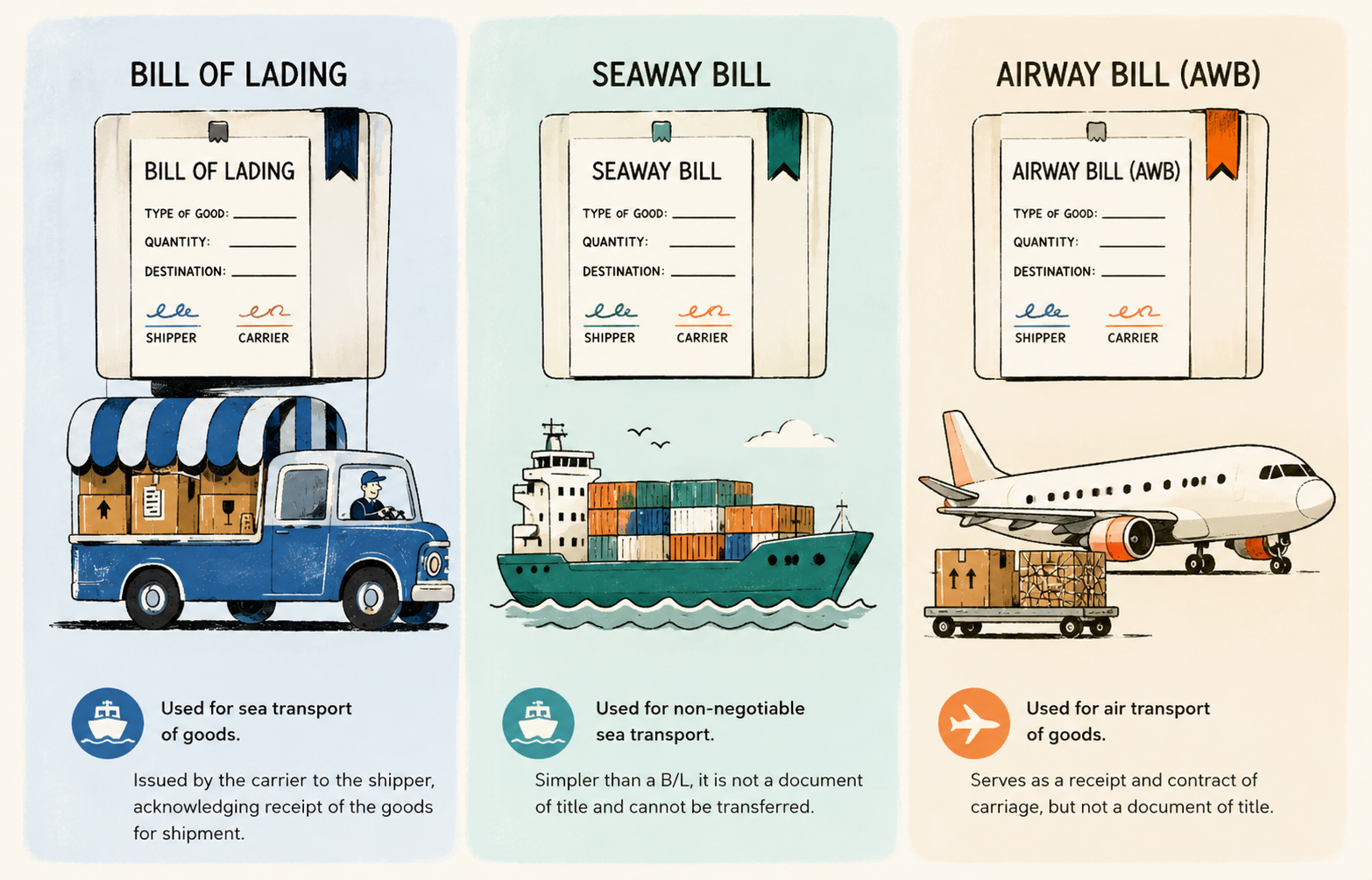
Here is the comparison of Bill of Lading, Seaway Bill, and Airway Bill side by side:
| Bill of Lading | Seaway Bill | Airway Bill (AWB) | |
| Receipt | YES | YES | YES |
| Contract of carriage | YES | YES | YES |
| Document of title | YES | NO | NO |
| Negotiable | YES | NO | NO |
| Original required at destination | YES | NO | NO |
| Used for | Sea / multimodal | Sea | Air |
The BoL is the only one that controls who owns the cargo. If your bank is involved, or goods might change hands in transit, you need a BoL — not a Seaway Bill, not an AWB.
How to Manage Bill of Lading Documents
Poor document management is one of the most common causes of port delays and payment disputes. Here is what you need to get right:
- Review the draft BoL before the vessel sails
Check every field — cargo description, quantities, consignee details, port information. A small typo can hold up customs at the destination. Once the vessel sails, amendments are slow and costly.
- Keep the original BoL safe
If you’re using a paper BoL, store it securely and avoid loss or damage. Replacing a lost original BoL can be time-consuming, expensive, and may delay cargo release.
- Use telex release or eBL to avoid courier delays
Couriering paper BoL originals takes time. Sometimes longer than the shipment itself. Here are two faster alternatives:
- Telex release — the shipper surrenders the original at origin, and the carrier releases the cargo at destination without a physical document.
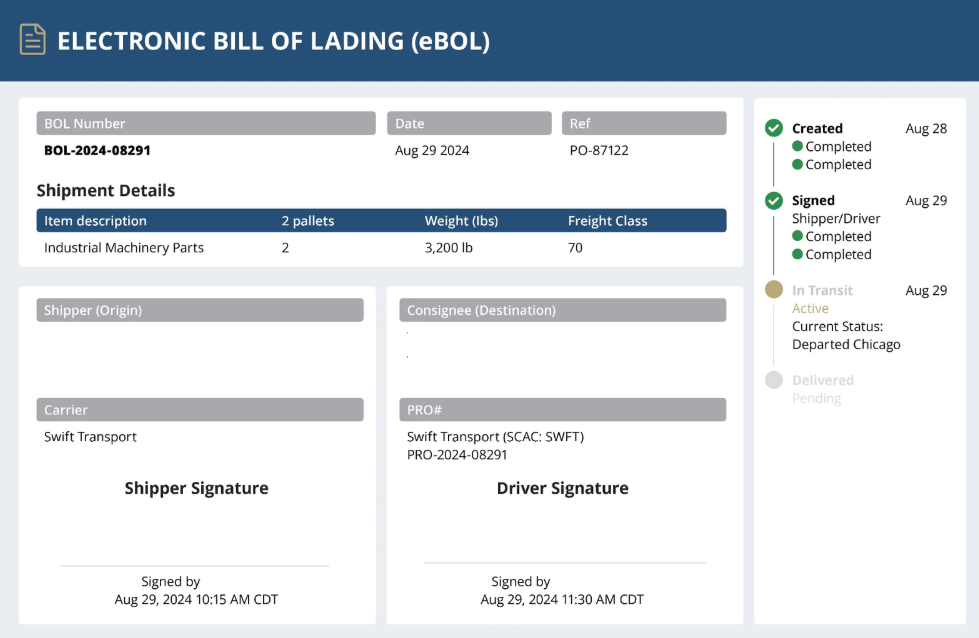
- Electronic BoL (eBL) — transfer takes seconds, cannot be lost, and leaves a full digital audit trail.
- Match your BoL against other shipping documents
Your BoL must align with your commercial invoice, packing list, and certificate of origin. Any mismatch can trigger a customs hold or block payment under a letter of credit.
Paper BoL vs. Electronic BoL
| Paper BoL | Electronic BoL (eBL) | |
| Speed | Days to courier | Seconds to transfer |
| Risk of loss | High | None |
| Amendment | Slow, costly | Fast, digital |
| Cost | Printing + courier fees | Platform fee only |
| Legal validity | YES | YES (in most jurisdictions) |
Note: If you ship frequently, ask your freight forwarder about switching to eBL — the time savings on document handling alone are significant.
FAQ About A Bill of Lading in Shipping
Q1: What Is the Purpose of a Bill of Lading?
The main purpose of a Bill of Lading is to prevent unauthorized cargo release and avoid disputes between the shipper, carrier, and consignee. It provides a clear record of the shipment and helps ensure the cargo reaches the correct party.
Q2: What Is the Bill of Lading Number Used For?
It is your unique tracking reference for the shipment. You use it to track your cargo with the shipping line. For example, COSCO tracking by bill of lading or Grimaldi tracking by bill of lading, both of which rely on this number. Keep it safe from the moment the BoL is issued.
Q3: Who Actually Issues the Bill of Lading?
The carrier holds legal responsibility for issuing the BoL. In practice, the shipping line issues the Master BoL to the freight forwarder, and the forwarder issues the House BoL to you. If you ship through a forwarder, they will usually prepare it on your behalf.
Q4: Is a Bill of Lading Legally Required?
Yes. Every shipment moving with a carrier — by road, sea, or air — requires one. For international shipments, it is also a mandatory customs document. No BoL means no customs clearance.
Q5: What Is the Difference Between a Bill of Lading and a Packing Slip?
A packing slip lists the contents of a package — it has no legal standing. A bill of lading is a legally binding contract between the shipper and the carrier. One is for picking and packing; the other controls the entire shipment.
Q6: What Is the Difference Between a Shipping Bill and a Bill of Lading?
A shipping bill is an export customs document filed with the customs authority at the origin, used to get export clearance. A bill of lading is issued by the carrier and travels with the goods. Both are required for international shipments, but they serve different purposes.
Final Thoughts
Now you know what a bill of lading is in shipping, and why getting it right matters every single time.If you are still unsure which type of BoL to use, how to fill in the form correctly, or how to handle a telex release, don’t guess. I recommend you talk to an experienced freight forwarder before booking; it’s the safest way.