Importing clothes from China can look simple at first: choose a style, agree on a price, and arrange delivery. In practice, the difficult part is making sure the garments match your specifications, carry the right labels, and arrive with documents that customs can understand.
If you are learning how to import clothes from China for the first time, this guide will help you plan the full shipment—from finding a suitable supplier and approving samples to choosing freight, preparing customs information, and estimating the shipping cost.
Why Import Clothes from China?
You can import clothes from China legally and efficiently, but the result depends on more than the factory price. You need to control product specifications, quality, shipping, customs classification, and the rules of your destination market.
China remains attractive because buyers can usually find:
- A wide range of fabrics, styles, and manufacturing capabilities
- OEM and private-label production for custom collections
- Flexible options for small test orders and large seasonal orders
- Competitive pricing for cut-and-sew, knitwear, outerwear, uniforms, and accessories
- Suppliers that can combine production, labeling, packing, and export preparation
Your real budget is the landed cost, not the unit price shown by the supplier. Include the product price, sample fees, labels, inspection, China pickup, export charges, freight, insurance, import duty, taxes, customs clearance, and local delivery.
If you are comparing suppliers and freight options, you can share your product type, quantity, package details, and destination with us. We can help you see the complete cost before you commit to a bulk order.
Source Clothing from the Right Chinese Market
Different Chinese sourcing centers are known for different clothing categories. The best market depends on your product, target price, order quantity, and required production speed.
Guangzhou and Dongguan for Fashion Apparel
Guangzhou and nearby Dongguan are practical starting points for fashion clothing, streetwear, denim, knitwear, activewear, and private-label collections. You can compare factories, wholesale markets, and sample rooms in one region.
Hangzhou and Ningbo for Women’s Clothing and Fast Fashion
Hangzhou is well known for women’s clothing and trend-focused products. Ningbo also has strong garment manufacturing and export experience. These areas may suit buyers who need updated styles, coordinated collections, and repeat production.
Yiwu for Small Orders and Accessories
Yiwu can be useful for smaller mixed orders, basic apparel, socks, hats, scarves, bags, and fashion accessories. You may find lower minimum order quantities, but always confirm the actual fabric, size range, packaging, and quality standard before placing the order.
Keqiao for Fabric and Custom Development
Keqiao is a major textile market. If you are developing a custom garment, sourcing fabric separately may give you more control over composition, weight, color, and finish. Ask the garment factory whether it will use your approved fabric lot or substitute materials.
Before paying a deposit, confirm:
- Fabric composition, fabric weight, color, size chart, and tolerances
- Minimum order quantity and price at different quantities
- Sample approval process and production lead time
- Carton dimensions, gross weight, and packing method
- Label, logo, hangtag, barcode, and packaging requirements
- Payment terms, inspection arrangements, and responsibility for defects
You can send us the supplier cities and estimated order details, and we can help coordinate pickup and consolidation when several factories are involved.
Which Shipping Method Fits Your Clothing Order?
For most commercial clothing orders, sea freight is the economical choice. Air freight and express shipping are better for samples, urgent replenishment, or high-value small cartons. The right method depends on volume, chargeable weight, deadline, and destination.
| Shipping Method | Best For | Typical Transit | Main Trade-Off |
| LCL Sea Freight | Small or mixed clothing orders | 25–50+ days | Lower entry cost, but shared handling and destination charges apply |
| FCL Sea Freight | Large seasonal orders or one-supplier production | 25–45+ days | Better control, but you pay for the container space |
| Air Freight | Samples, launch stock, and urgent replenishment | 5–12 days | Faster, but billed by chargeable weight |
| Express Shipping | Samples, labels, accessories, and small cartons | 3–7 working days | Convenient tracking, but the unit cost is high |
| Rail Freight | Selected China–Europe routes and medium-volume cargo | 18–30 days | Availability and final delivery depend on the route |
If you want a door-to-door arrangement, DDP may simplify the process because duties, taxes, and delivery can be included in one quotation. Still, confirm who is responsible for the importer information, customs entry, product compliance, and any inspection. A low DDP price is not useful if the service scope is unclear.
For a clearer comparison, you can provide us with your cargo volume, destination postcode, and required delivery date.
What Documents Do You Need to Import Clothes from China?
The exact document list depends on the destination and product, but a commercial clothing shipment normally needs a complete shipping file. Inconsistent information is one of the easiest ways to create customs questions.
| Document | Key Details |
| Commercial Invoice | Seller, buyer, product description, quantity, value, origin, and Incoterm. |
| Packing List | Carton count, garment details, weight, dimensions, volume, and shipping marks. |
| Bill of Lading / Air Waybill | Consignee, cargo details, package count, and transport release method. |
| HS Code & Importer Details | Correct HS code, country of origin, importer tax number, and registration details. |
| Compliance Documents | Required fiber labels, test reports, care labels, and product certificates, if applicable. |
If you’re unsure which documents you need, feel free to contact us for guidance. Send us your invoice, packing list, product photos, and destination details. We can help check for missing shipping information before booking.
How Can You Check Clothing Quality Before Importing Bulk from China?
You protect quality best by turning the product idea into written specifications before production, then checking the actual goods before they leave the factory. A product photo is not a quality standard.
Define the Garment Specification
Write down the fabric composition, weight, measurements, stitching, trims, zipper or button type, color reference, logo position, label content, and acceptable tolerances. For clothing, a few centimeters of measurement difference can change the fit and create expensive returns.
Approve a Real Production Sample
Ask for a physical sample before confirming the full order. Check the hand feel, fabric density, color, shrinkage, stitching, seams, print or embroidery, wash result, and size chart. If the factory changes fabric or trims after approval, request a new approval sample.
Use Pre-Shipment Inspection
For a larger order, an inspection can check workmanship, measurements, quantity, labels, carton packing, and visible defects. You can use a third-party inspection company or arrange a warehouse inspection before the shipment is released.
Check Packing for Moisture and Compression
Folded clothes are often packed in polybags and cartons. Confirm whether vacuum packing is suitable for the product, because excessive compression can crease or deform some garments. Add moisture protection when the route, season, or storage conditions create a higher risk.
You can share your approved sample photos, inspection checklist, and packing requirements with us. We can coordinate cargo receiving, inspection, repacking, labeling, and consolidation before international shipping.
Estimated Transit Time of Shipping Clothes from China
Door-to-door timing depends on the factory-ready date, pickup city, consolidation, transport schedule, customs clearance, and final delivery postcode. The table below gives planning ranges for common routes and transport methods, so you can compare the likely time from pickup arrangements through final delivery.
| Shipping Route | Air | Sea LCL / FCL | Rail | Truck | Express |
| China to USA | 5–14 days | 16–30 days | — | — | 3–5 work days |
| China to Europe | 6–14 days | 30–50 days | 25–35 days | 20–30+ days | 3–5 work days |
| China to UK | 6–14 days | 30–40 days | 28–32 days | 20–28+ days | 3–5 work days |
| China to Canada | 6–14 days | 20–45 days | — | — | 3–5 work days |
| China to Australia | 5–12 days | 20–25 days | — | — | 3–5 work days |
| China to UAE | 5–14 days | 20–30 days | — | — | 2–4 work days |
| China to South Africa | 8–15 days | 45–50 days | — | — | 5–7 work days |
| China to Singapore | 2–5 days | 10–12 days | — | — | 2–4 work days |
| China to Philippines | 2–5 days | 10–15 days | — | — | 2–4 work days |
| China to Thailand | 2–3 days | 10–12 days | — | — | 2–4 work days |
| China to Malaysia | 2–5 days | 10–12 days | — | — | 2–4 work days |
These estimates can change because of vessel schedules, peak seasons, port congestion, customs inspection, weather, holidays, and final-mile arrangements. Production time is separate from transportation time, so include sampling and manufacturing lead time in your launch plan.
If your sales date is fixed, you can tell us your cargo information, and we can compare the available sailing or flight schedules and help you build a more realistic buffer.
Clothing Shipping Costs from China
Door-to-door clothing freight is priced by route, chargeable weight, volume, carton dimensions, season, and the services included. The table below gives route-based planning ranges.
| Route | Air | Sea LCL/FCL | Rail | Truck | Express |
| China to USA | $7-$12/kg | LCL: $100-$250/CBM; FCL: $1,500-$4,500/cont. | – | – | $7-$28/kg |
| China to Europe | $5-$9/kg | LCL: $80-$180/CBM; FCL: $1,500-$5,000/cont. | $1-$3/kg | $2-$5/kg | $6-$25/kg |
| China to UK | $5-$9/kg | LCL: $100-$200/CBM; FCL: $1,800-$5,000/cont. | $1-$3/kg | $2-$5/kg | $6-$25/kg |
| China to Canada | $4-$10/kg | LCL: $100-$220/CBM; FCL: $2,000-$5,000/cont. | – | – | $7-$28/kg |
| China to Australia | $5-$12/kg | LCL: $80-$180/CBM; FCL: $1,500-$4,000/cont. | – | – | $8-$30/kg |
| China to UAE | $4-$13/kg | LCL: $80-$160/CBM; FCL: $1,200-$3,500/cont. | – | – | $5-$20/kg |
| China to South Africa | $7-$22/kg | LCL: $120-$250/CBM; FCL: $2,500-$6,000/cont. | – | – | $8-$32/kg |
| China to Singapore | $2-$8/kg | LCL: $50-$120/CBM; FCL: $800-$2,000/cont. | – | – | $5-$15/kg |
| China to Philippines | $2.5-$8/kg | LCL: $60-$150/CBM; FCL: $900-$2,500/cont. | – | – | $5-$15/kg |
| China to Thailand | $3-$5/kg | LCL: $50-$120/CBM; FCL: $800-$2,000/cont. | – | $1.5-$4/kg | $0.8-$3.0/kg |
| China to Malaysia | $2.5-$7/kg | LCL: $50-$120/CBM; FCL: $600-$2,000/cont. | – | – | $5-$15/kg |
These figures are general planning estimates, not firm quotes. The LCL/FCL reference excludes other charges; DTD rates may exclude duty, VAT/GST, insurance, storage, inspections, remote-area delivery, and other destination fees unless the quotation specifically states DDP or all-inclusive coverage. Rates change with the sailing date and cargo details, so a shipment-specific quote is needed before the order is confirmed.
You can provide us with the supplier city, destination postcode, carton dimensions, gross weight, total CBM, and preferred delivery date. We will use those details to prepare a more practical shipping comparison.
Clothing Compliance Depends on the Destination Market
When you ship clothes internationally, the rules aren’t the same everywhere. Each country has its own requirements for customs duties, fiber labels, care instructions, product safety, and importer information. Before your goods leave China, it’s worth checking what your destination market requires so you can avoid unnecessary delays and extra costs.
United States
If you’re shipping clothing to the US, make sure the labels accurately show the fiber content, country of origin, and responsible company information where required. Children’s clothing may also need additional safety testing and documentation.
If your garments contain cotton or other materials that could raise forced-labor concerns, you should review the U.S. forced-labor import guidance before arranging shipment.
United Kingdom and European Union
For the UK and EU, you’ll need to check the fiber-labeling rules and any product-specific requirements that apply to your clothing. If you’re importing into the EU, the Access2Markets trade portal can help you check tariffs, taxes, customs procedures, and product requirements. For the UK market, you can refer to the UK textile labelling guidance before finalizing your labels.
Canada
If you plan to sell clothing in Canada, check whether your products need fiber-content labels and dealer or importer identification. Requirements can vary depending on the product and how it’s sold, so it’s best to confirm the details before printing labels for your entire order. You can find more information in the Canadian textile labelling guidance.
Australia and Other Markets
Shipping to Australia or another market? Don’t assume the same labels will work everywhere. Depending on your destination, you may need to check care-label requirements, country-of-origin claims, consumer protection rules, and product safety standards.
We recommend confirming the required language, label format, care symbols, and supporting documents with your importer or customs broker before production is complete.
One more thing: be careful with branded clothing. If your products carry another company’s logo or are described as replicas, make sure you have the legal rights and authorization required to import them. Customs authorities may detain counterfeit goods, and a low purchase price won’t protect you from intellectual-property issues.
If you are unsure which labels, test reports, or customs details apply to your destination, you can send us the product category, material, destination country, and photos. We can help organize the shipping file and connect the cargo plan with the applicable import requirements.
Real Case Studies: Shipping Clothing from China
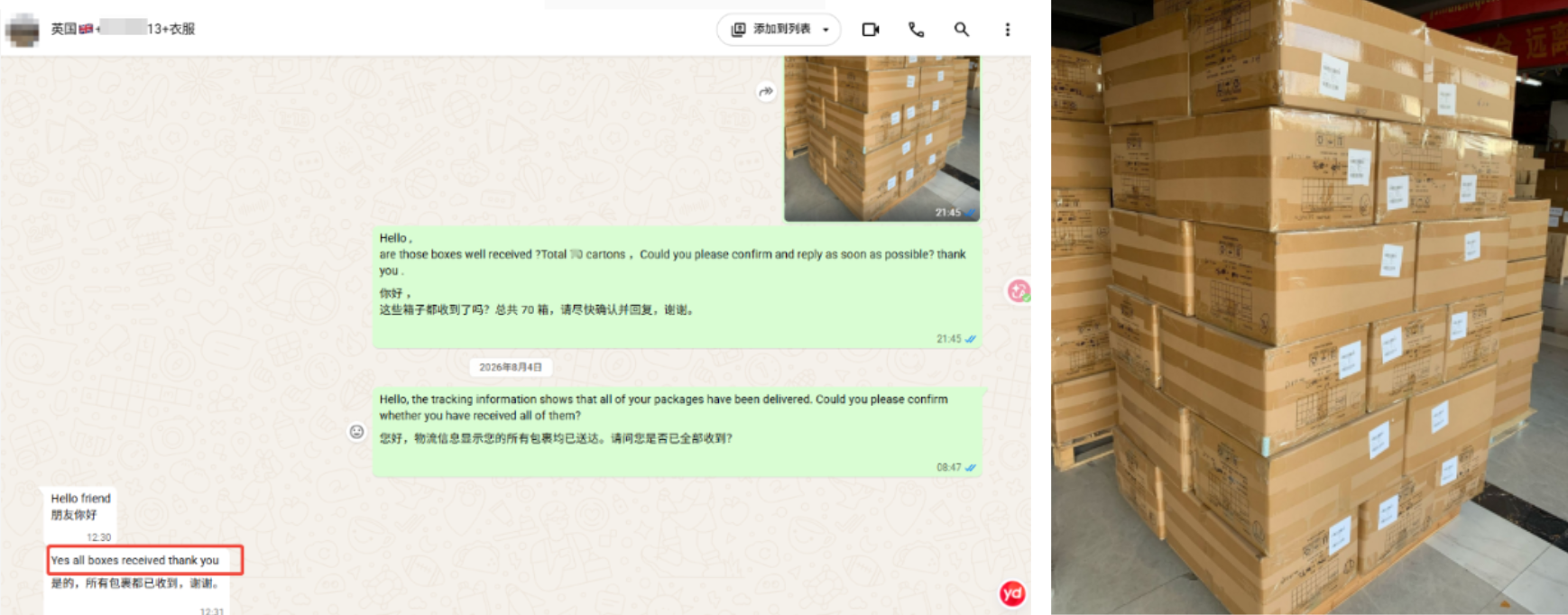
Case Study 1: Shipping Clothing (1,690 KG, 70 Cartons) from China to UK by Rail Freight DDP
Customer Source: Customer Referral
Cargo Type: Clothing
Chargeable Weight: 1,690 KG
Cargo Quantity: 70 Cartons
Shipping Route: Guangzhou, China to Manchester, UK
Shipping Method: Rail Freight DDP Door-to-Door
Transit Time: Approximately 33 Days
The customer was a clothing buyer sourcing products from Guangzhou for the UK market. He wanted to compare air and rail freight costs, simplify customs clearance, and arrange convenient delivery to Manchester.
- Supplier Pickup & Warehouse Receiving: We collected the 70 cartons from the supplier in Guangzhou and transported them to our Shenzhen warehouse, saving the customer from arranging domestic transportation.
- Air and Rail Freight Comparison: We compared air and rail freight quotations. The customer selected rail freight for its balance of shipping costs and transit time.
- Cargo Preparation & Insurance: Our warehouse team checked the shipment and prepared the 1,690 KG of clothing for dispatch. We offered cargo insurance at 0.05% of the declared cargo value. Although the calculated premium was approximately US$1.78, the minimum charge at the time was RMB 80, which became the final insurance fee.
Price Note: The insurance rate and minimum premium reflect the terms available at the time of shipment. Current rates, minimum charges, and coverage conditions may differ and should be confirmed before booking.
- Rail Freight DDP Arrangement: We arranged Rail Freight DDP Door-to-Door shipping from China to the UK, based on the customer’s budget and delivery requirements.
- Customs Clearance & Tax Handling: Under the agreed DDP terms, we coordinated UK import customs clearance and handled applicable duties and taxes, simplifying the import process for the customer.
- Final Door-to-Door Delivery: After customs clearance, we arranged final delivery to the customer’s address in Manchester.
The shipment was successfully delivered in approximately 33 days, and the customer was very satisfied with our shipping arrangements and service.
Case Study 2: Shipping Clothing (3,303 KG, 231 Cartons) from China to USA by Sea Freight DDP

Customer Source: DFH Freight Website Inquiry
Cargo Type: Clothing
Chargeable Weight: 3,303 KG
Cargo Quantity: 8 Pallets (231 Cartons)
Shipping Route: China to USA
Shipping Method: Sea Freight DDP Door-to-Door
Transit Time: 40 Days After Departure
The customer was a US business owner who had recently launched an online store and was unfamiliar with importing goods from China. She needed help consolidating clothing from multiple suppliers, preparing shipping documents, and handling US customs clearance.
- Multi-Supplier Cargo Consolidation: We coordinated with the customer’s suppliers and received the clothing at our warehouse. After all the goods arrived, we checked and consolidated the shipment to simplify transportation.
- Cargo Inspection & Reinforced Packaging: Our warehouse team checked the cargo quantity and visible condition, then arranged reinforced packaging to improve protection during handling and sea transportation.
- Supplier Coordination & Document Support: We communicated with the suppliers to confirm the cargo details and collect the necessary shipping information and documents before departure.
- Sea Freight with DDP Arrangement: Based on the shipment volume and the customer’s needs, we arranged Sea Freight DDP Door-to-Door shipping from China to the USA, providing a practical solution for her online business.
- US Customs Clearance & Tax Handling: Under the agreed DDP terms, we coordinated import customs clearance and handled applicable duties and taxes, allowing the customer to avoid managing the import procedures herself.
- Final Door-to-Door Delivery: After customs clearance, we arranged final delivery to the customer’s designated address in the USA, eliminating the need for her to coordinate separate local transportation.
The shipment was transported to the USA in 40 days after departure. Our consolidated shipping and DDP service helped the customer simplify the import process for her online store.
If you are importing clothing from China to your destination, you can share your supplier locations, carton quantity, total weight, and delivery address with us. We can help arrange cargo consolidation, DDP service, customs clearance, and Door-to-Door delivery.
FAQs About Importing Clothes from China
Can I Import Clothing Samples Before Placing a Bulk Order?
Yes. Samples are a sensible way to check fabric, fit, color, workmanship, and packaging before you commit to a larger quantity. Keep the sample approval record and make sure the bulk order is produced to the same written specification.
Can I Use My Own Brand Labels on Clothing Made in China?
Yes, many factories produce private-label clothing, but you should approve the label artwork, fiber wording, country-of-origin statement, care instructions, and placement before production. The final label still needs to meet the rules of the country where the garments will be sold.
Are Used Clothes Treated Differently from New Clothes?
Often, yes. Used clothing may be subject to additional sanitation, quarantine, documentation, or import restrictions depending on the destination. Confirm the rules before arranging collection, especially when the goods are donated, mixed, or not individually documented.
Can Clothing Be Insured Against Moisture or Mold?
Yes, we can help arrange cargo insurance through Ping An Insurance or China Pacific Insurance (CPIC), with rates starting from 0.05% of the insured value for eligible shipments. However, moisture, condensation, mold, and poor packaging may be excluded or subject to specific conditions. You can contact us before shipping to confirm the available coverage, exclusions, and suitable packaging precautions.
Final Thoughts
To import clothes from China successfully, treat sourcing, quality control, shipping, customs, labeling, and final delivery as one connected plan. The lowest unit price is not always the lowest landed cost, especially when incorrect labels, poor packing, delays, or customs questions affect the shipment.
You can send us your supplier city, garment type, quantity, carton dimensions, gross weight, destination country, and preferred delivery date. We’ll review your requirements, compare suitable shipping options, and recommend a practical freight solution for your clothing order. For an overview of the process from inquiry to delivery, read our shipping guide.