A clothing order can move quickly from a Chinese supplier to Malaysia, but a fast route does not always mean a simple import. The product description, fibre content, invoice value, tariff code and delivery location all affect what happens after the cartons reach Malaysia.
If you plan to import clothes from China to Malaysia, think about the shipment as a complete landed-cost project. We will walk through the Malaysia-specific documents, taxes, product information, shipping choices and delivery details that deserve attention before your supplier hands over the cargo.
Import Clothes from China to Malaysia: Start with the Landed-Cost Question
China and Malaysia are closely connected by short sea routes, frequent air services and established supplier networks. That makes Malaysia attractive for clothing orders, but the supplier price is only the first line in your budget.
Your real landed cost may include:
- Product price and sampling
- Pickup from the Chinese supplier
- Export handling and documentation
- Sea, air or express freight
- Customs duty and Malaysian sales tax, where applicable
- Customs clearance and destination handling
- Insurance, storage and final-mile delivery
A low freight rate can become expensive if it excludes Port Klang charges, customs service, tax handling or delivery beyond the port. Before comparing quotations, decide whether you need port-to-port, airport-to-airport or a genuinely door-to-door service.
If you are comparing suppliers in Guangzhou, Shenzhen, Shanghai, Yiwu or other sourcing locations, you can share the purchase details with us early. We can help you estimate the complete logistics picture before the cargo is ready.
What Does Malaysia Need Before Your Cargo Arrives?
For a normal commercial clothing shipment, Malaysia usually needs a complete invoice, packing list, transport document, import declaration and supporting documents submitted through the appointed importer or customs agent. Extra permits or approvals apply when the goods are controlled, restricted, used or subject to a special claim.
The Core Document Set
| Document | Purpose | Malaysia-Specific Check |
| Commercial invoice | Shows seller, buyer, garment description, quantity, value, currency, Incoterm and origin. | Use product-level descriptions instead of only “clothes” or “fashion goods”. |
| Packing list | Matches carton numbers, SKU quantities, dimensions and gross weight. | Keep carton marks consistent with the warehouse receiving sheet. |
| Bill of lading or AWB | Identifies carrier, shipper, consignee, routing and transport terms. | Check the consignee and notify the party before the document is issued. |
| Customs Form No. 1 (K1) | Provides the import declaration used for customs clearance. | HS/AHTN code, value, origin and quantity should match the invoice. |
| MyCIEDS supporting files | Submits the invoice, packing list, origin proof and other supporting documents electronically. | Confirm the appointed importer or agent can submit the files. |
| Certificate or proof of origin | Supports a preferential tariff claim when the trade agreement and origin rules are satisfied. | Form E or another accepted proof must agree with the K1 declaration. |
| Permit or approval, if relevant | Required for controlled, restricted, used or special-category goods. | Check the current Prohibition of Imports Order before shipment. |
The Royal Malaysian Customs Department (RMCD) requires the import declaration to match the supporting documents. A description such as “clothes” is too broad for a shipment containing shirts, dresses, trousers and jackets with different materials and tariff lines.
The declaration normally needs the correct package count, quantity, weight, value, country of origin and HS/AHTN classification. If an import licence or approval is required for a specific product, it should be ready before the goods arrive, not requested after the cargo is held.
MyCIEDS and Electronic Supporting Documents
Malaysia uses MyCIEDS for electronic submission of supporting documents linked to customs declarations. The system may require documents such as the invoice, packing list, certificate of origin, exemption letter or other relevant approval in an accepted file format.
If needed, we can prepare the shipment file in a consistent format so the invoice, packing list, transport document, and declaration tell the same story.
Build a Garment File before You Confirm the Order
A good garment file prevents many avoidable questions. Ask the supplier to confirm the following details for every SKU:
- Garment type and intended use
- Fibre composition and blend percentages
- Size range, colour, quantity and SKU
- Country where the garment was made
- Unit price, total value and currency
- Number of cartons, carton dimensions and gross weight
- Ready date and supplier pickup address
- Whether the cargo is new, returned, used, branded or private label
If you buy from several factories, keep one master spreadsheet and ask each supplier to use the same SKU names. This makes warehouse receiving, consolidation and customs description much easier.
Keep Fibre Claims and Product Photos Consistent
A supplier may describe a garment as cotton, while the final item contains polyester, elastane or another blended fibre. Keep the material specification, product photo, label artwork and commercial invoice aligned.
Confirm the Origin Statement
China origin should be stated accurately. Do not confuse the seller’s location, the designer’s location and the manufacturing origin. If you intend to claim preferential treatment under an applicable China–Malaysia trade arrangement, the proof of origin must agree with the import declaration and commercial documents.
Check Brand and Product Claims
Words such as “genuine,” “organic,” “silk,” “leather,” “bamboo,” “halal” or “official” should be supported by evidence. A misleading claim can create a product or consumer-compliance issue even when the freight itself is arranged correctly.
We can review the supplier’s product sheet, package details and label draft before booking. That small check often saves more time than correcting an inconsistent declaration at the port.
Where Do Malaysia’s Duties, SST and Tariff Code Fit?
Malaysia does not apply one universal import duty to all clothing. The amount depends on the exact HS/AHTN classification, material, garment construction, origin, customs value and whether a preferential tariff claim is accepted.
Import sales tax is also product-specific. The current Malaysian sales-tax orders include rates such as 5%, 10% or a specific rate for particular goods, so you should verify the exact treatment for the declared tariff line instead of assuming that every clothing shipment uses the same percentage.
Classification Comes before the Calculation
A cotton knitted T-shirt, a woven polyester dress, a waterproof jacket and a textile accessory may not use the same tariff line. Use a product-level description and ask the customs agent to confirm the applicable AHTN code before the invoice is finalized.
Form E Is Not an Automatic Zero-Duty Ticket
China-origin clothing may qualify for preferential tariffs under ACFTA when it meets the applicable product-specific rules of origin and the required Form E is provided. The origin documents must also match the customs declaration and supporting records.
Customs Value Should Reflect the Real Transaction
Do not lower the invoice simply to reduce duty or tax. Keep the purchase order, payment record, freight information and commercial invoice available in case customs asks for supporting evidence.
The current Malaysia sales-tax orders and Royal Malaysian Customs rules-of-origin guidance should be checked for the exact tariff treatment at the time of import.
You can send us the garment type, fibre content, supplier invoice value and delivery postcode. We can help you separate freight cost from the customs and tax assumptions before you make a decision.
Labels and Product Information for Malaysian Sales
Malaysia does not use one single clothing-label template for every garment, but that does not mean product information can be vague or misleading. Your sewn-in label, hangtag, packaging and online product description should tell the same story.
Fibre, Care and Size Information
Keep the fibre content and care instructions accurate and easy for customers to understand. If the clothing will be sold through a retailer or marketplace, check that channel’s own label and product-data requirements before production.
Country of Origin and Importer Details
Use an accurate origin statement and keep it consistent with the invoice and customs declaration. If a local retailer, private-label owner or importer needs its own name on the packaging, confirm the arrangement before the factory prints the final labels.
Special Claims Need Evidence
Children’s clothing, protective workwear, garments with chemical finishes and products carrying safety or performance claims may need additional review. A label that promises flame resistance, waterproofing or a special treatment should be supported by the relevant test or supplier record.
You can send us the label artwork and a product photo with your quotation request. We can flag obvious mismatches between the label, packing list and customs description before your clothes leave China.
Which Route Makes Sense for Your Clothing Shipment?
For most commercial clothing orders, sea LCL is the cost-focused choice, while FCL becomes practical when the cartons occupy a large part of a container. Air freight and express are better when the shipment is small, urgent or connected to a product launch.
| Shipping Method | Best For | Typical Time Door-to-Door | Malaysia Planning Note |
| Sea LCL | Mixed cartons and smaller commercial orders | 14–22 days | Allow for destination charges and local delivery. |
| Sea FCL | Full containers and steady inventory | 14–22 days | Useful when volume makes a dedicated box economical. |
| Air Freight | Launch stock and urgent replenishment | 2–6 days | Volume weight may exceed actual weight. |
| Express | Samples and small parcels | 2–6 work days | Confirm tax and clearance scope before booking. |
Beyond choosing the shipping method, your delivery location in Malaysia also affects the most suitable route. Port Klang is a common gateway for Kuala Lumpur and much of Peninsular Malaysia. Tanjung Pelepas can be practical for Johor and nearby areas, while Penang may reduce inland transportation for northern destinations. Shipments to Sabah and Sarawak require separate routing and delivery arrangements.
Once you know your destination and cargo volume, you can compare the available routes and delivery options. Explore our shipping from China to Malaysia service to learn how supplier pickup, international transportation, customs support, and final delivery can be arranged together.
Door-to-Door Transit Times from China to Malaysia
Malaysia is a relatively short-distance lane, but the door-to-door calendar still includes warehouse receiving, export handling, vessel or flight schedules, customs processing and local delivery.
| Route | Sea Door-to-Door | Air Door-to-Door | Express Door-to-Door |
| Shenzhen/Guangzhou → Port Klang | 14–20 days | 2–5 days | 2–6 work days |
| Shanghai/Ningbo → Port Klang | 15–20 days | 2–6 days | 2–6 work days |
| Xiamen → Port Klang | 15–20 days | 2–6 days | 2–6 work days |
| Shenzhen → Tanjung Pelepas | 14–20 days | 2–5 days | 2–6 work days |
| China → Sabah / Sarawak | 15–22days | 2–6 days | 2–6 work days |
These ranges are planning estimates, not guaranteed delivery dates. A shipment to Kuala Lumpur or Johor Bahru may move differently from one going to Penang, Kota Kinabalu or Kuching. Chinese New Year, Malaysia public holidays, peak-season warehouse congestion and customs inspections can also affect the final date.
You can provide us with your cargo-ready date and Malaysian postcode, and we will help you work backward from the date when the clothes need to be available.
How Much Does It Cost to Import Clothes from China to Malaysia?
As a planning reference, LCL rates for China–Malaysia clothing shipments may sit around US$50–170 per CBM, FCL around US$600–2,200 per container, air freight around US$2.0–9.0 per kg, and express around US$5.0–15 per kg before all local and customs-related charges are confirmed.
| Route | Sea LCL | Sea FCL | Air | Express |
| Shenzhen/Guangzhou → Port Klang | US$50–130/CBM | US$600–2,000/cont. | US$2.0–8.6/kg | US$5.0–15/kg |
| Shanghai/Ningbo → Port Klang | US$50–140/CBM | US$700–2,100/cont. | US$2.8–9.0/kg | US$5.0–15/kg |
| Xiamen → Port Klang | US$65–150/CBM | US$700–2,000/cont. | US$2.5–8.8/kg | US$5.0–15/kg |
| Shenzhen → Tanjung Pelepas | US$50–165/CBM | US$600–2,100/cont. | US$2.5–8.8/kg | US$5.0–15/kg |
| China → Sabah / Sarawak | US$50–170/CBM | US$600–2,200/cont. | US$2.0–9.0/kg | US$5.0–15/kg |
The table shows freight references, not a final landed-cost quotation. Prices may change depending on carton dimensions, chargeable weight, cargo volume, carrier capacity, fuel surcharges, destination postcode, customs scope, and whether you choose port-to-port or Door-to-Door service.
You can contact us today for a free shipping quote. We’ll help you compare suitable freight options and arrange a cost-effective shipping solution based on your cargo and delivery requirements.
Special Cases: Used Clothes, Branded Goods and East Malaysia
Some clothing shipments need additional checks before leaving China. If your order includes used garments, branded products, or deliveries to East Malaysia, make sure you understand the relevant requirements before booking.
1. Used Clothing & Textile Returns
Used clothes, worn garments, textile waste, and returned stock may face additional import controls.
- Import Permission: Check whether your goods require an import permit or special approval before shipping.
- Accurate Declaration: Do not declare used clothing as new merchandise to avoid additional checks.
- Pre-shipment Review: If you plan to import used garments, confirm the applicable requirements before arranging supplier pickup.
2. Branded Clothing & Restricted Goods
If you are importing branded clothing, make sure the products are legally sourced and supported by appropriate documents.
- Keep your supplier invoices and brand authorization documents where applicable.
- Check the authenticity and sourcing of branded products before shipment.
- Avoid counterfeit or unauthorized branded goods, which may lead to customs detention or other enforcement problems.
Important: A DDP shipping arrangement does not make prohibited or restricted goods acceptable for import. We recommend checking product eligibility before confirming your shipment.
3. Shipping Clothes to Sabah and Sarawak
If your delivery address is in Sabah or Sarawak, we need to consider the destination and local transportation arrangements when planning the route.
Before booking, we recommend checking:
- Shipping Gateway: Whether Port Klang, Penang, Tanjung Pelepas, or an air gateway is suitable for your destination.
- Delivery Location: Your final postcode and the available local transportation options.
- Delivery Conditions: Whether your address requires a delivery appointment, special unloading equipment, or additional handling.
If your shipment includes used or branded clothing, let us know in advance. We can help review your shipping requirements, compare suitable freight options, and arrange cargo pickup, customs coordination, and Door-to-Door delivery. Contact us today for a free shipping quote!
A Malaysia-Ready Shipping Workflow
1. Confirm Your Import Information
We collect your SKU list, product materials, quantities, cargo value, country of origin, package details, and intended delivery address. These details help us prepare an accurate quotation and check the relevant customs requirements before shipping.
2. Coordinate Directly with Your Suppliers
You don’t need to handle every supplier communication yourself. With your authorization and supplier contact details, we can communicate directly with your factories or trading companies to confirm cargo readiness, packing information, and delivery schedules.
We can also arrange pickup from different Chinese cities or coordinate deliveries to our Shenzhen warehouse.
3. Receive and Consolidate Your Cargo
Once your cartons arrive at our warehouse, we check the quantities and visible packaging condition. If your shipment needs additional preparation, we can also arrange consolidation, repacking, palletizing, or relabelling before dispatch.
4. Check Your Shipping Documents
We help review your commercial invoice, packing list, transport documents, and origin information, along with any permits or approvals required for your products. Before departure, we confirm the shipping method and agreed service scope with you.
5. Arrange Transportation and Keep You Updated
Based on your cargo volume, budget, and delivery deadline, we arrange sea freight, air freight, or express shipping, with DDP terms where agreed. We also keep you informed of important shipment milestones, from supplier pickup and departure to arrival and local delivery.
6. Coordinate Malaysian Customs Clearance and Final Delivery
After the customs procedures are completed, we arrange delivery to your nominated warehouse, shop, fulfillment center, or business address. If your destination is in West Malaysia, Sabah, or Sarawak, we check the local routing and delivery arrangements based on your postcode.
You can share your cargo details with us when the goods are nearly ready. We will help turn supplier information into a clear Malaysia shipping plan with fewer handoffs for you to manage.
Our Real Case Studies: Shipping Clothing from China to Malaysia
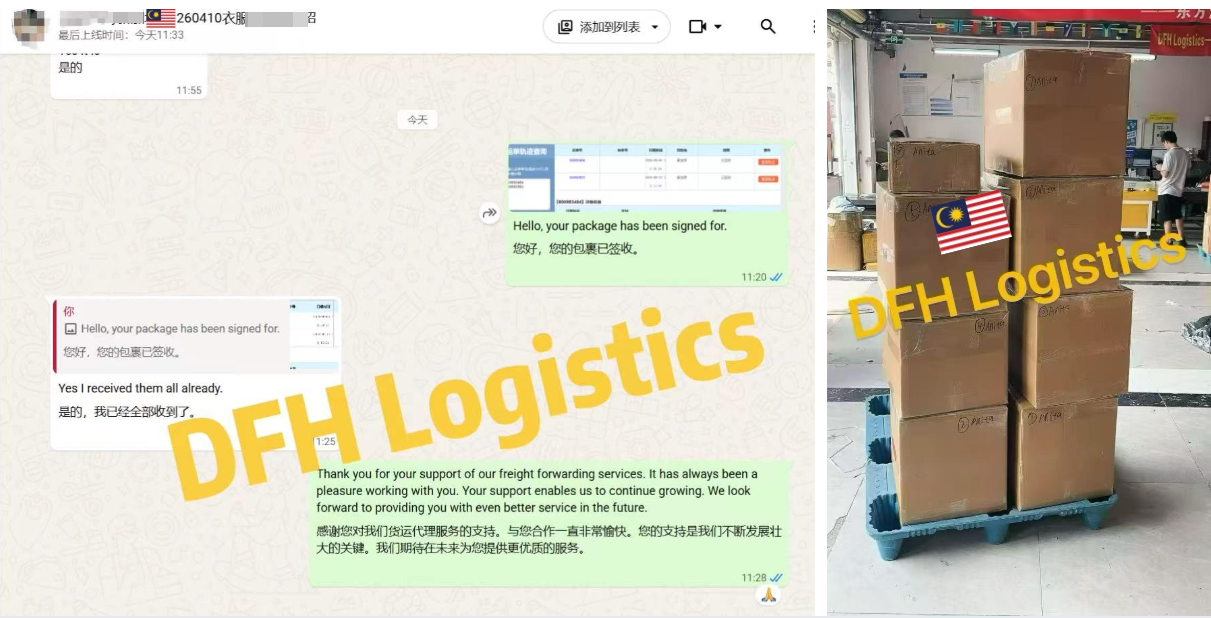
Customer Source: Official Website Inquiry
Cargo Type: Clothing (Taobao Purchases)
Chargeable Weight: 234 KG
Cargo Quantity: 10 Cartons
Shipping Route: China to Malaysia
Shipping Method: Sea Freight DDP Door-to-Door
Transit Time: 13 Days
The customer contacted us through our official website after purchasing clothing from multiple Taobao orders. They needed a convenient way to receive their purchases in China, consolidate the goods, and deliver everything directly to their address in Malaysia without handling international shipping and import procedures themselves.
- Taobao Order Receiving: We provided our Shenzhen warehouse address for the customer’s Taobao purchases. The suppliers sent the clothing directly to our warehouse, eliminating the need for the customer to arrange separate international shipments.
- Cargo Counting & Information Checking: After receiving all 10 cartons, our warehouse team counted the packages and checked the cargo information to ensure the shipment details were properly recorded.
- Shipping Document Verification: Before dispatch, we checked the commercial invoice, packing list, and product descriptions to ensure the declared information was consistent with the actual clothing shipment.
- Sea Freight with DDP Arrangement: Based on the cargo weight of 234 KG, we arranged Sea Freight DDP Door-to-Door from China to Malaysia. This provided a cost-effective solution with international transportation and destination import procedures included under the agreed service scope.
- Customs Clearance: We coordinated import customs clearance and handled applicable duties and taxes under the agreed DDP arrangement, saving the customer from managing complicated import procedures independently.
- Final Door-to-Door Delivery: After customs clearance, we arranged local transportation and delivered all 10 cartons directly to the customer’s designated address in Malaysia.
The shipment was successfully delivered to Malaysia within 13 days. The customer appreciated the convenient Taobao receiving service, careful cargo checking, and smooth Door-to-Door delivery.
If you also need to ship clothes from China to Malaysia, send us your order details, estimated carton quantity, and delivery address. We can help receive your purchases at our Shenzhen warehouse and arrange a suitable shipping plan with DDP Door-to-Door delivery.
FAQ about Importing Clothes from China to Malaysia
Do I Need a Malaysian Company to Import Commercial Clothing?
Commercial imports normally need a suitable importer or appointed customs agent in Malaysia. The exact registration and declaration arrangement depends on the importer, cargo and customs process, so confirm the setup before booking.
Are Clothes from China Subject to SST in Malaysia?
They may be subject to import sales tax and possibly customs duty, depending on the current tariff line and applicable exemption or preference. The exact treatment should be checked against the current Malaysian tax orders.
Does ACFTA Always Remove Import Duty on Chinese Clothes?
No. Preferential treatment is conditional. The garment must satisfy the applicable origin rules, and the proof of origin must match the import declaration and supporting documents.
Can I Send a Clothing Order to Sabah or Sarawak by the Same Route as Kuala Lumpur?
Not always. East Malaysia may need a different port, flight or local delivery arrangement, and the final transit time can be longer. The destination postcode should be included when comparing options.
Final Thoughts
Importing clothes from China to Malaysia requires careful planning of shipping, customs clearance, taxes and delivery. Understanding these steps helps avoid delays and unexpected costs.
Planning your next clothing shipment? Send us your garment type, supplier city, carton quantity, dimensions, cargo value, and Malaysian delivery postcode. We can compare LCL, FCL, air freight, express, and DDP options to help you choose a suitable shipping solution.